
Popcorn Ceiling Removal Hamilton: Stoney Creek, Mountain, Dundas, Condos and Basements
Updated June 12, 2026
Hamilton homeowner guide to popcorn ceiling removal, including Stoney Creek, Hamilton Mountain, Ancaster, Dundas, Waterdown, painted texture, condos, basements, dust control, project scenarios, and FAQs.
- Trusted since 2005
- Fully insured
- Dust-controlled sanding
- Paint-ready finishing
- 3-year workmanship warranty
Quick Answer
Popcorn ceiling removal in Hamilton should be priced as a finished ceiling project, not only a scrape. Painted texture, older homes, Hamilton Mountain basements, Stoney Creek condos, Dundas and Ancaster trim details, HEPA dust control, asbestos questions, skim coating, primer, and flat ceiling paint all affect the right scope.
Hamilton homeowners usually start with one question: how do we get rid of the popcorn ceiling without turning the house into a dusty mess or ending up with a rough ceiling after paint? The short answer is that the removal stage is only one part of the job. The smoother final result comes from protection, texture testing, repair, skim coating, dust-controlled sanding, primer, and flat ceiling paint.
For the full service scope, start with professional popcorn ceiling removal. For city availability and neighbourhood coverage, use the Hamilton popcorn ceiling removal page. This guide connects the local project details that usually change Hamilton quotes.
Popcorn Ceiling Removal Hamilton
For a ceiling project within a larger renovation, the Waterdown page explains how to sequence lighting, surface finishing and protection of new floors or cabinets. See Waterdown ceiling renovation planning.
Popcorn ceiling removal Hamilton projects vary because the city has a wide mix of homes. A standard-height bedroom on the Mountain, a condo in Stoney Creek, a character home near Durand, and a larger Ancaster or Waterdown main floor can all need different protection, different repair assumptions, and different finish standards.
A useful Hamilton quote should not stop at square footage. It should identify whether the texture is painted or unpainted, whether the home is occupied, whether there are old stains or cracks, whether the ceiling height is standard, whether furniture can be moved, and whether the homeowner wants a paint-ready ceiling or a fully primed and painted ceiling.
The finished ceiling is judged after daylight, pot lights, wall paint, flooring, and furniture are back in place. That is why a scrape-only price can be misleading. It may remove texture, but it may not include the work that makes the ceiling look smooth after final paint.
Stoney Creek popcorn ceiling removal
Stoney Creek popcorn ceiling removal often involves condos, townhomes, lake-area homes, and family houses where access and dust control matter as much as the ceiling area. Condo units may need elevator booking, hallway protection, parking instructions, work-hour planning, and compact material staging. Townhomes can have tight stairs and less space to move furniture out of the room.
Bright windows and pot lights can also make the ceiling less forgiving. If the room has long sightlines or strong side light, the quote should explain skim coating, sanding, primer checks, and how the ceiling will be inspected before final paint.
For the matching local page, see Stoney Creek popcorn ceiling removal.
Hamilton Mountain popcorn ceiling projects
Hamilton Mountain popcorn ceiling projects often include bungalows, split-level homes, finished basements, rec rooms, bedrooms, and main-floor refreshes. Standard ceiling heights can make some rooms more predictable, but basements, stairwells, bulkheads, and previous DIY repairs can change the scope quickly.
The Mountain is also where homeowners often ask about doing several rooms at once. If bedrooms, hallways, and basement ceilings are being handled together, the quote should explain phasing, dust containment, room availability, drying time, and when furniture can safely return.
Ancaster/Dundas/Waterdown service area
Ancaster, Dundas, and Waterdown projects often bring different finish concerns. Ancaster homes may have larger open rooms, taller foyers, vaulted areas, and stronger daylight. Dundas homes may have older trim, hardwood floors, plaster transitions, or renovation history that makes the ceiling less predictable. Waterdown homes can include newer subdivisions, townhomes, and main-floor renovations where pot lights, flooring, and painting need to be sequenced correctly.
For neighbourhood-level service pages, review Ancaster popcorn ceiling removal, Dundas popcorn ceiling removal, and Waterdown popcorn ceiling removal.
Painted vs unpainted popcorn ceiling
Painted versus unpainted popcorn ceiling is one of the biggest quote factors. Unpainted texture may soften and release more predictably after a test area. Painted texture is sealed, so moisture does not reach the texture evenly. Scraping can tear drywall paper, leave texture shadows, or push the project into broader skim coating.
Hamilton homeowners often do not know whether a ceiling was painted by a previous owner. Clues include a harder sealed surface, slight sheen, roller marks, or texture peaks that look bridged together. Photos help, but a small test area is usually the better confirmation.
| Situation | What it usually means | Quote item to confirm |
|---|---|---|
| Unpainted texture | May scrape cleaner after testing, but the exposed drywall can still show seams and old patches. | Confirm repair allowance, skim coating, primer, paint, and cleanup. |
| Painted texture | Usually slower because paint seals the texture and can increase drywall paper damage. | Confirm test patch, skim-coat method, dust-controlled sanding, primer, and paint. |
| Older or stained texture | Can raise asbestos, leak, stain-blocking, or repair questions before normal finishing. | Confirm safety checks, stain-block primer, and excluded hazardous-material work. |
Basement ceiling removal Hamilton
Basement ceiling removal Hamilton projects need extra attention because lower levels often have bulkheads, plumbing access, old patches, lower ceiling heights, and less airflow for drying compound. A basement ceiling may look like a simple scrape until the texture comes off and exposes old leak marks, tape seams, access-panel patches, or uneven board transitions.
Basements can also slow drying time. Humidity, closed rooms, and limited ventilation affect skim coats and primer. A realistic schedule should allow compound and primer to dry properly instead of forcing paint onto a surface that is not ready.
Condo popcorn ceiling removal Hamilton
Condo popcorn ceiling removal Hamilton projects are usually logistics-heavy. The ceiling may be smaller than a detached home, but access can be more controlled. Ask about elevator booking, parking, hallway protection, building work-hour rules, waste handling, furniture protection, dust control, and daily cleanup.
Condo rooms also tend to be bright, especially near large windows. That light can reveal sanding marks, patch edges, and skim-coat ridges after paint. The quote should explain how the ceiling will be checked under real light before final handoff.
HEPA dust control process
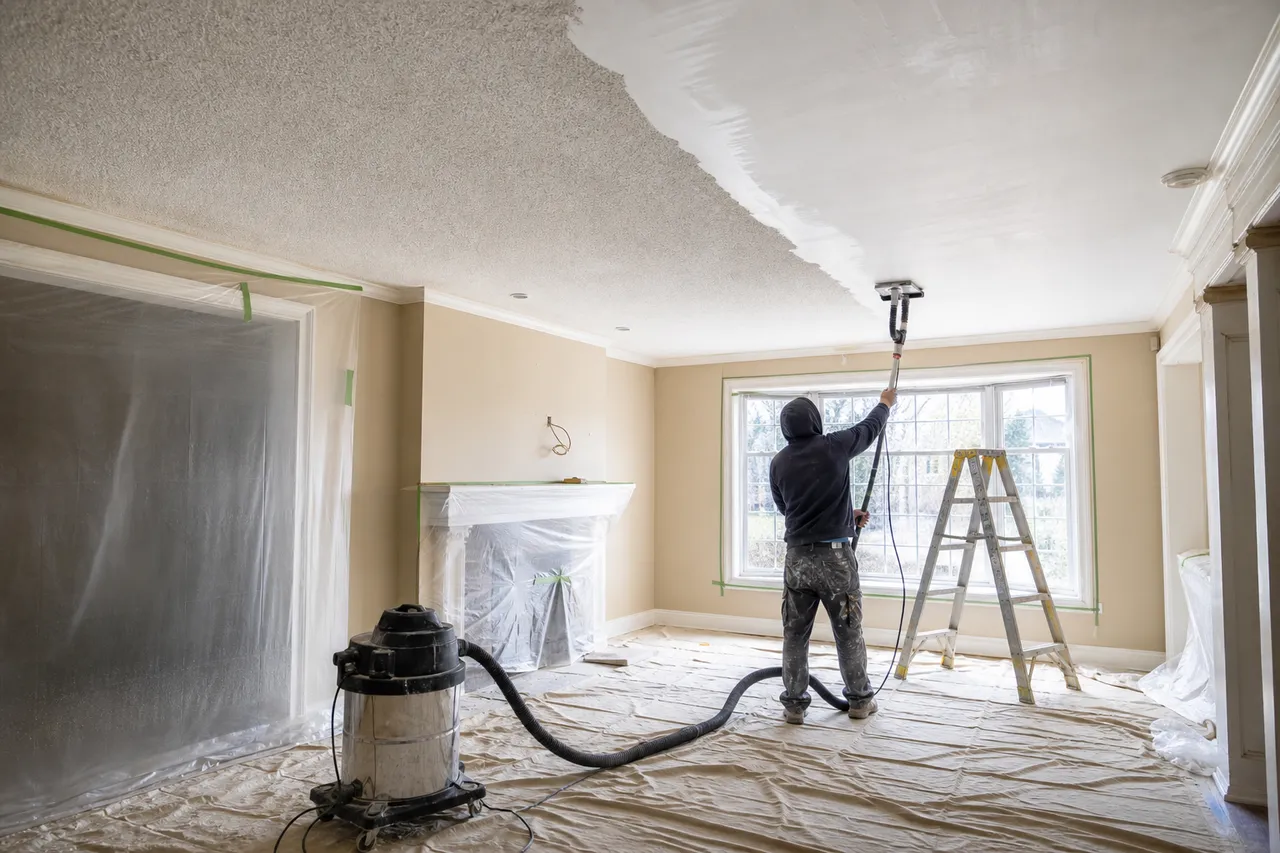
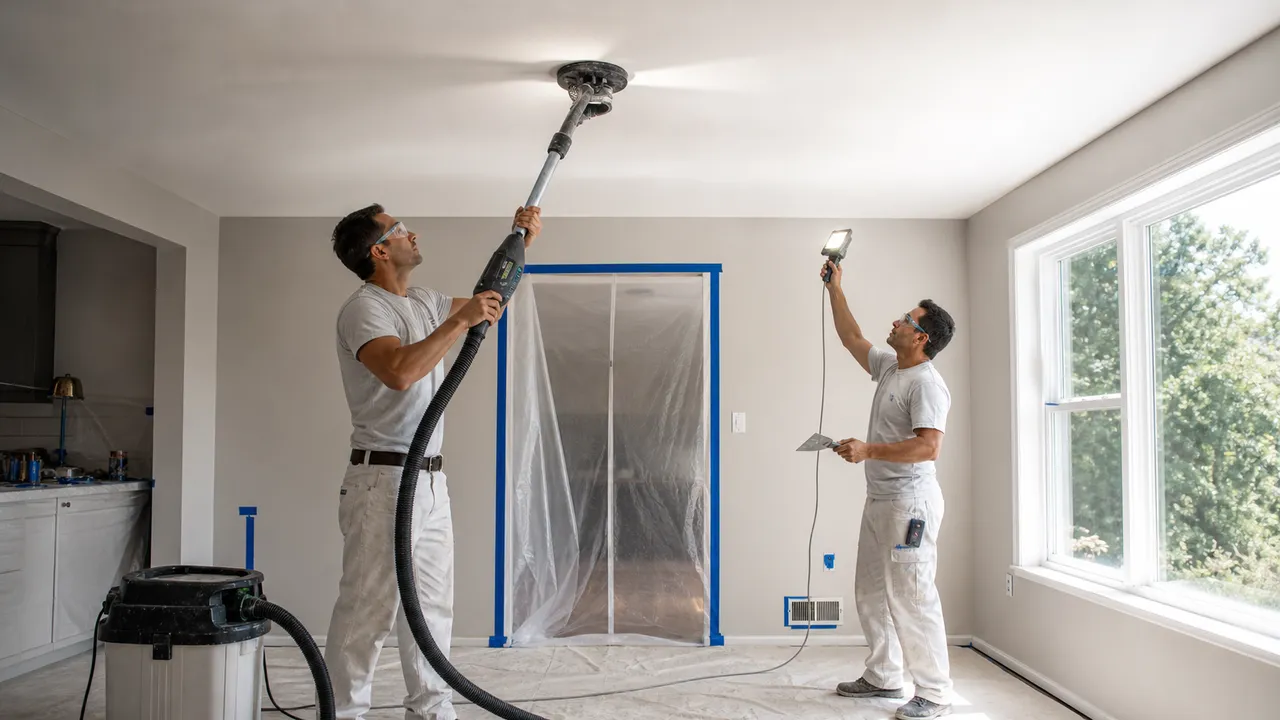
A realistic dust-control process begins before the ceiling is disturbed. Floors, walls, vents, fixtures, cabinets, counters, doorways, and traffic paths should be protected. The crew should isolate the work zone where possible, keep debris controlled during removal, and use vacuum-assisted sanding or HEPA-connected dust control during the fine-dust stages.
No contractor should promise that a ceiling job creates no dust at all. The better promise is a controlled process: planned containment, protected vents, managed sanding, cleanup before primer, and daily housekeeping when the project spans more than one day.
Before/after Hamilton project photos
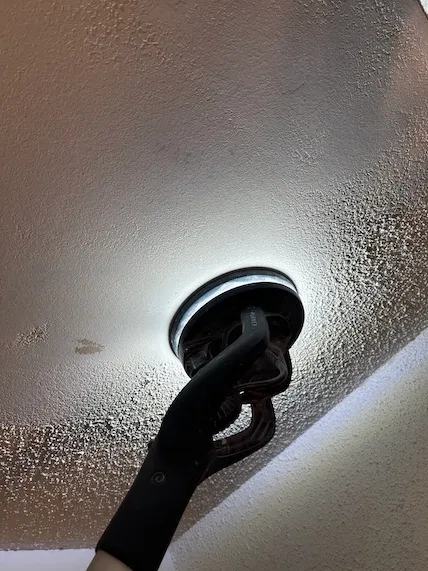
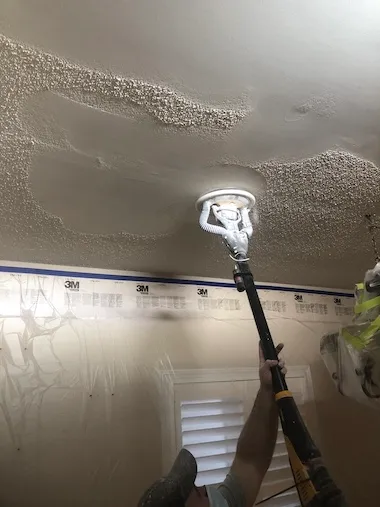
The photos on this guide show the kind of conditions Hamilton homeowners should look for when comparing a quote: a protected room before removal, a dust-control setup during sanding, and a smooth ceiling after repair, skim coating, primer, and paint. They are visual planning examples, not a claim that every photo is a verified Hamilton job.
Before photos should capture the room wide enough to show access, furniture, ceiling height, lights, vents, and texture condition. Close photos should show whether the popcorn looks painted, stained, cracked, or loose. After photos should be judged under daylight and normal room lighting, not only while the ceiling is freshly finished under work lights.
Recent project examples with intersections/neighbourhoods
Because unverified job stories should not be invented, the examples below are practical Hamilton quote scenarios rather than fake completed projects. They show how location, home type, and ceiling condition can change the scope a homeowner should ask about.
| Neighbourhood or intersection | Typical ceiling issue | What the quote should confirm |
|---|---|---|
| Upper James and Mohawk Road | Hamilton Mountain bedroom or hallway with standard-height popcorn and furniture that may need to stay nearby. | Room protection, furniture movement, drying time, primer, paint, and whether the texture is painted. |
| King Street East and Centennial Parkway | Stoney Creek condo or townhome ceiling with access rules, bright windows, and compact staging. | Elevator or parking logistics, hallway protection, dust control, skim coating, and daily cleanup. |
| Main Street West and Dundurn Street | Older lower-city or Westdale-style room with possible old repairs, trim details, or mixed ceiling history. | Asbestos/testing question where relevant, old patch repair, trim protection, and finish-level expectations. |
| Rymal Road and Upper Wentworth Street | Basement or lower-level ceiling with bulkheads, old access patches, and slower drying conditions. | Moisture history, access panels, bulkhead edges, ventilation, sanding cleanup, and paint boundary. |
Cost, timeline, and quote scope
Hamilton popcorn ceiling removal cost depends on square footage, ceiling height, painted texture, repair depth, building type, furniture, access, dust control, primer, paint, and cleanup. Small single-room projects are often priced as a minimum project because setup and protection still take real labour. Larger rooms may be easier to compare by square footage once the scope is clearly defined.
Timeline usually depends on drying and finish stages as much as removal. A simple room can move faster than a painted main floor, condo, basement, or old patched ceiling. If primer reveals sanding marks or low spots, touch-ups before final paint are part of getting a better finish, not a failure of the job.
FAQ about cost, timeline, dust, asbestos, painting
The FAQ below covers the main Hamilton questions homeowners ask before sending photos: price, schedule, dust control, asbestos checks, and whether painting should be included in the quote.
What a complete Hamilton quote should include
A complete Hamilton quote should make the end condition clear. Homeowners should know whether the ceiling will be scraped only, repaired and paint-ready, primed, or fully painted with flat ceiling paint. Those are different stopping points. If two quotes use the same phrase but stop at different stages, the cheaper number can become the more expensive choice after the work starts.
The written scope should list room names, approximate square footage, ceiling height, whether the texture appears painted, what protection is included, how furniture will be handled, whether vents and traffic paths are protected, what dust-control steps are used during sanding, and whether primer and paint are included. It should also say how ordinary small repairs are handled and which larger issues are excluded.
For Hamilton, homes can range from older lower-city rooms and Westdale character houses to Mountain bungalows, Stoney Creek condos, Ancaster open-concept spaces, Dundas older trim details, and Waterdown townhomes. That is why a local quote should be more specific than a generic square-foot number. The ceiling may be the same size as another room, but access, light, furniture, drying conditions, and old repair history can make the work very different.
Room-by-room planning before booking
Not every room in a Hamilton home needs the same finish budget. Main floors, living rooms, kitchens, dining rooms, condo great rooms, and basement rec rooms usually matter most because they are seen daily and often have stronger lighting. The rooms that get the strongest daylight, longest sightlines, or most attention usually deserve the most careful skim coating and primer checks. Secondary rooms can still be finished properly, but the quote may be simpler if the light is softer and the ceiling condition is cleaner.
Open-concept spaces need special planning because there may not be an obvious place to stop. If a living room, dining room, kitchen, and hallway share one continuous ceiling plane, the quote should define whether the whole plane is included or whether a natural break exists. Stopping in the wrong place can leave a visible transition after paint.
Basements, hallways, stairwells, and small bathrooms are not automatically easy. Basements may have bulkheads and slower drying. Hallways need traffic planning. Stairwells can require safer access equipment. Bathrooms may have moisture history, fans, and smaller surfaces that still need careful edge work.
Skim coating, full removal, or a blended method
The best method depends on what the ceiling allows. If the texture is unpainted and releases cleanly after testing, controlled removal may be practical. If the texture is painted, bonded hard, or likely to tear drywall paper, a skim-heavy resurfacing method can be safer and produce a better finished surface. Some homes need a blended approach because one room behaves differently from another.
Homeowners sometimes assume full removal is always better. In reality, forcing a scrape on sealed painted texture can create torn paper, gouges, and extra repair work. The better question is not whether every speck of texture comes off. The better question is which method creates the smoothest, most stable ceiling after primer and paint.
Hamilton rooms with older repairs, basement bulkheads, Stoney Creek condo windows, or Hamilton Mountain pot lights usually need the finish plan defined before work starts. If the room has pot lights, large windows, or an updated interior, the finish standard should be discussed before pricing. A weak ceiling finish can make the rest of a renovation look unfinished.
Primer, paint, and why flat ceiling paint matters
Primer is not just a product line in the quote. It is an inspection step. Raw joint compound can look acceptable before primer, then reveal sanding scratches, low spots, patch edges, or flashing once sealed. A good process leaves room to touch up small flaws after primer instead of pretending the first sanded pass is always the final surface.
Flat ceiling paint is usually the safest finish for smooth ceilings because it reduces reflection. Shiny or higher-sheen paint can make small imperfections easier to see, especially where daylight or pot lights wash across the ceiling. Paint should not be expected to hide rough sanding, weak feathering, or raised patch edges. The surface has to be right before paint can look right.
If another painter is handling the final coat, the handoff point should be clear. Paint-ready can mean sanded and ready for primer, or it can mean primed and ready for finish paint, depending on how the contractor uses the term. Ask before comparing quotes.
DIY limits and when professional help makes sense
Popcorn ceiling removal looks simple from the floor because the visible goal is easy to understand. The hard parts are overhead protection, controlled removal, dust management, avoiding drywall paper damage, repairing exposed defects, skim coating evenly, sanding without waves, priming correctly, and making the ceiling look calm after paint.
DIY becomes riskier when the ceiling is painted, older, high, stained, cracked, above a main living area, connected to pot-light work, or possibly old enough to raise asbestos questions. In those situations, the cost of fixing a rough attempt can be higher than planning the finish correctly from the start.
A homeowner can still do useful prep before professional work begins. Clear the room where possible, remove fragile items and electronics, take good photos, note ceiling height and room size, and share any history of leaks, patches, previous painting, asbestos testing, or electrical plans.
Access, scheduling, and living in the home during work
Hamilton access can mean street parking in tighter lower-city areas, easier driveway staging on the Mountain, elevator or hallway rules in condos, and longer material routes in larger west-end homes. The crew needs a clear route for tools, protection, compound, ladders, sanding equipment, vacuums, and waste. If parking, elevators, stairs, narrow entries, pets, work-from-home schedules, or children affect the home, those details should be discussed before the project date.
Rooms under active ceiling work are usually not usable during the dusty or wet stages. If the home is occupied, the quote should explain whether the work can be phased room by room, what daily cleanup looks like, where materials will be staged, and when furniture can return. A good schedule respects drying time instead of rushing compound and paint because the room is inconvenient to lose.
What photos to send before asking for a price
Send one wide photo of each room from two corners if possible. Add a close photo of the texture, a photo around lights and vents, and photos of any cracks, stains, old patches, crown moulding, bulkheads, skylights, smoke detectors, speakers, or ceiling fans. Include rough room dimensions and ceiling height.
Also send practical access details: whether the room is furnished, whether large furniture can move out, whether the home is occupied, whether the work is part of a larger renovation, whether pot lights are planned, and whether there is a deadline for listing photos, move-in, flooring, or painting. These details help the contractor quote the real scope instead of a best-case version of the room.
Questions to ask before you approve the work
Before approving a quote, ask: What removal method are you assuming? What happens if the ceiling is painted? Is skim coating included? Is sanding connected to dust control? Is primer included? Is flat ceiling paint included? How are repairs handled? What is excluded? How many days will the room be unavailable? What information do you need from me before day one?
Those questions protect both sides. The homeowner gets a clearer price and fewer surprises. The contractor gets better starting information and can plan the room properly. Most ceiling problems happen when the scope is vague, not when the homeowner asks too many practical questions.
How this guide supports the local service page
This guide is written to support the Hamilton popcorn ceiling removal service page with deeper homeowner planning information. The service page explains availability and the main offer. This blog explains the project decisions behind the quote: painted texture, dust control, finish level, room access, photos, safety questions, timeline, and painting. Together, those pages give homeowners a clearer path from research to a useful written estimate.
Bottom line for Hamilton homeowners
The best Hamilton popcorn ceiling quote is the one that explains the finished ceiling, not only the texture removal. Ask about painted versus unpainted texture, protection, HEPA dust control, repair, skim coating, primer, flat ceiling paint, cleanup, and exclusions before comparing prices.
FAQ
How much does popcorn ceiling removal cost in Hamilton?
Cost depends on room size, ceiling height, painted texture, repairs, furniture, access, primer, paint, and cleanup. Photos, room dimensions, and ceiling height are needed for a useful written quote.
How long does popcorn ceiling removal take in Hamilton?
Many simple rooms take a few working days once drying is included. Painted ceilings, basements, condos, high ceilings, old repairs, and full paint scope can take longer.
Is popcorn ceiling removal dusty?
Yes, ceiling work creates debris and fine sanding dust. A better process uses containment, protected vents, floor and wall protection, HEPA-connected sanding, and cleanup before primer.
Should I test for asbestos before removing popcorn ceiling in Hamilton?
If the ceiling is older and the material history is uncertain, testing should be considered before scraping, sanding, drilling, or removal. Do not disturb suspect material based on a guess.
Does painting happen after popcorn ceiling removal?
It can. A full smooth-ceiling scope usually includes repair, skim coating, sanding, primer, and flat ceiling paint. Some quotes stop at paint-ready, so confirm this in writing.
Drywall service pages and guides
Plan the Right Drywall Service Next
popcorn ceiling removal
Main service page for removal, skim coating, sanding, primer, and painting.
drywall repair
Repair service for ceiling cracks, patches, leak damage, and paint-ready surfaces.
Mississauga popcorn ceiling removal
Local ceiling removal and smooth finishing page for Mississauga homeowners.
popcorn ceiling removal cost guide
Cost factors for painted texture, access, room size, repairs, primer, and paint.
professional popcorn ceiling removal
Main service page for removal, ceiling repair, skim coating, HEPA dust control, primer, and flat ceiling paint.
Hamilton popcorn ceiling removal
Local service page that this guide supports with city-specific ceiling removal context.
Stoney Creek popcorn ceiling removal
Local Hamilton service page for Stoney Creek condos, townhomes, and homes.
Dundas popcorn ceiling removal
Neighbourhood page for Dundas homes where older trim, hardwood, and ceiling history can affect prep.
Field Photos
What the Work Can Look Like
Article Review
AuthorEPF Pro Services
Reviewed byEPF Pro Services
UpdatedJune 12, 2026
Plan your drywall scope
Get a drywall quote today
Share photos, room sizes, and timing. We reply the same day with Hamilton drywall availability and a clearer written scope.
Quick next step